Posts relating to arts projects (writing, curating, etc.)
-
Kim Hill this morning
I listened with interest this morning to Kim Hill interviewing designer David Trubridge. An intriguing conversation, it left me wondering if there is an unfair expectation in the media for local design businesses to be our flag bearers for eco-sustainability. Positioning an ecological and sustainable ethos above the economic realities of running a business as ethically as possible – in the face of a domestic economy reliant on cheaply imported goods – is a challenge that most mainstream businesses manage to successfully avoid. So why does contemporary design seem to cop it? Are we looking for the answers to our oil and pollution problems in designing fancy lightshades? It is a difficult territory, so hats off to Hill for taking the time to chat with Trubridge, who’s website has the contemporary buzzword of ‘sustainability’ stamped all over it.
David Trubridge is a successful local design business inspired by native flora and fauna of New Zealand and as such is promoted heavily to the domestic market (as well as internationally). He employs intelligent local designers and makers, as well as mostly local materials and production processes.
Trubridge’s company employs a profitable domestic business model in which New Zealanders can take confidence. Kim Hill uncovers – in stripping away some of the Trubridge PR veneer and deftly avoiding too much rhetoric about what Trubridge clearly perceives as our lack of national identity – that inasmuch as it could appear to be yet another a design brand built up on a confusing blend of new age hyperbole, glossy magazines and featuring in important public museum collections, this business has its roots in the old ethos of skilled craftspeople making things locally from available resources.
This is where the discussion becomes important. Sustainable making practices have always been around and seem to me extremely simple, elegant. It seems we almost need the whole ethos of this way of living repackaged, glamorised and even perhaps legislated.
At one stage in the conversation, Trubridge tells a simple yet interesting story about building a house in the early stages of his career, which relates to the direction of his present business. It is an interesting corollary for the ecologically sound remnants of ‘pre-oil’ economy design processes and the environmental issues which we are currently staring down the barrel of: “What’s interesting about that time was that we instinctively looked for the best solutions. We could go down and buy cheap pine and stuff at the hardware store, but we went to the recycling yards and bought teak decking from ships – things like this – we built the house sort of as the way builders had always done it in rural areas of Britain; stone buildings that last forever; that kind of attitude without thinking that’s what we did. It’s interesting that now looking back on it, that’s a real model for our times.”
-
Volume Contemporary Craft/Object Symposium

Volume, for everyone who missed it, was a great excuse to head for the Hawkes Bay. Highlights were Justin Paton’s keynote, the Sunday craft market, which I left with a wallet lighter but with a handful of small works by Lex Dawson, Paul Maseyk and Ross Mitchell Anyon, and being invited to share my notes onstage as part of a selection of eight professional colleagues presenting examples of contemporary makers and practices to keep an eye on.
-
Metonymy exhibition
Italo Calvino once asked: “Whom do we write a novel for? Whom do we write a poem for?” Calvino answered his own question: “For people who have read a number of other novels, a number of other poems. A book is written so that it can be put beside other books and take its place on a hypothetical bookshelf.”
The proposition behind the Metonymy exhibition is to my eyes a similar question and it is a fitting project for our post-everything social climate. One problem in literature and the fine arts is that each is so finely enmeshed in its respective “hypothetical bookshelf” that the audience – often peers – draw conclusions which are often way off the mark from what the writer, poet or artist may have intended. Metonymy addresses this gap.
When words and visual arts occasionally collude the results are perhaps even more unpredictable than each would be on its own. As noted above, writers, poets and artists, similar to a degree through holding creative occupations, employ differing methodologies which relate intricately to the shared traditions and received wisdom of their respective crafts.
Combining authorial voices, as proposed by the instigators of the Metonymy project, has allowed artists and writers to develop an understanding of each others languages in the process of teaming up on a project. The sharing of knowledge in this peer reviewed environment appears to have had a largely positive flow-on in this instance and a number of great new works are the result.
Not taking anything away from academic endeavours, the purpose of the Metonymy project has the simple aim of creative people enriching one anothers knowledge. In many ways it is more generous – both for the participants and the viewer – than most art exhibitions and for this the organisers should be commended.
Matt Blomeley
Metonymy. Cross Street Studios, Auckland, 14-24 May 2008
-
Pick Up Your Cave And Run

The artists featured in Pick Up Your Cave And Run suggest alternative positions from which to view our notions of home. A fundamental trait that apparently defines man from beast, the strong desire we all have to construct a private space serves as a repository of all manner of things meaningful. Not merely a shelter for sleeping, our “caves” are also a social space and necessary for emotional wellbeing. As our oldest ancestors discovered, caves are great places to store objects of personal relevance.Bar the occasional ascetic individual (an indulgent position nowadays), we all have a desire to furnish personal space. But space is not only physical. Our contemporary existence as liminal, internet-based ‘social networking’ machines indicates that times are changing and that our perceptions of personal space may also be changing. For many individuals, including the artists in this exhibition, the definition of home is determined more by work and current circumstances than how space is furnished.
Free online services mean that even those among us whom society would like to ignore are now able to exist in multiple social circles off the grid. Of course this is part and parcel of a proviso that one is willing to exist online as a social avatar of oneself. If so, it is quite easy to exist socially with negligible personal contact to anyone in ones sphere of influence. With access to permanent free digital services and land line phones becoming a thing of the past, perhaps we will one of these days no longer be required or in fact want to actually maintain a physical residence?
The relationship between objects and our sense of place is opened up for examination by the artists in this exhibition. Explorations range from our continued obsession with handicrafts to consideration of the urban and natural environment. The role of objects and materials is a central factor in each of these projects. Pick Up Your Cave And Run reflects on domesticity from a generation of New Zealanders who have matured in a rapidly changing post colonial economy.
Matt Blomeley
Pick Up Your Cave And Run features the work of artists Chris Hargreaves, Andrea Du Chatenier, Tim van Dammen, Andrew Rankin, Rachel Bell, Nick Taylor, Kate Barton, and Danielle Clayton and will be on show at RAMP gallery in Hamilton March 18 – April 4, 2008.
-
Redefining Agility on stuff.co.nz
Article by Scott Morgan.
-
Top Tens exhibition PDF
 From Top Tens at Snowhite, August 2005 curated by Matt Blomeley. A PDF catalogue of this project can be downloaded from here. It’s getting a bit long in the tooth already but it’s worth a download. Top Tens features ‘anonymous’ writing/top ten lists from twenty one artists and academics; Dan Arps, Eu Jin Chua, Danielle Vermeer Clayton, Yasmin DuBrau, Richard Fahey, Elspeth Fougrere, Jennifer French, Vincent Lum, Grace Peters, Miriam Harris, Joel Kefali, MJ Kjarr (Matt Blomeley), Alethea Nathan, Janine Randerson, Nicholas Spratt, Tim Thatcher, Hannah May Thompson, Mandy Thomsett Taylor, Vegard Toresen, Krystie Wade, Kathy Waghorn.
 -
Redefining Agility Opening
-
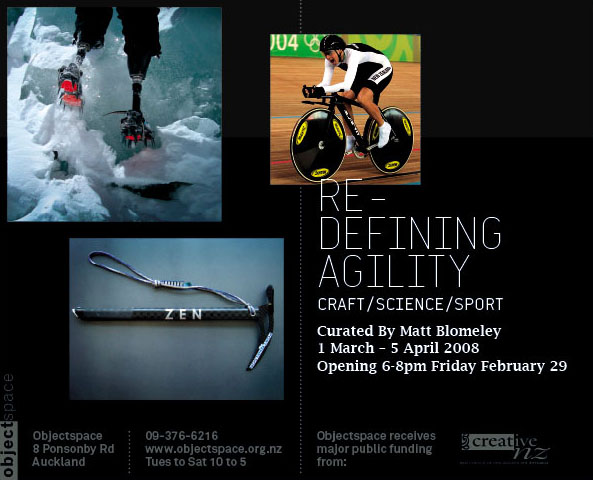
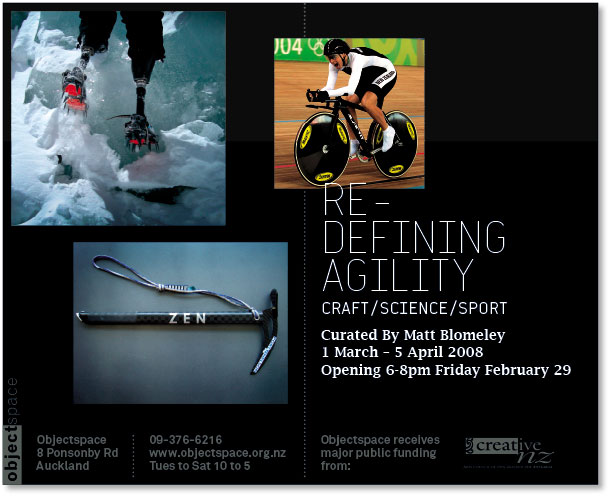
Redefining Agility: Craft – Science – Sport
“Nature crafts materials of a complexity and functionality that we can only envy” – Janine Benyus
The designers and engineers featured in Redefining Agility apply contemporary manufacturing processes and materials to the production of specialist sporting equipment. Their objects expand the notion that craftsmanship and new technologies may go hand-in-hand. Henry Petroski has observed that “engineering is the art of compromise.” Many designers and engineers, including those featured in Redefining Agility, are fusing new scientific and material developments.
It sometimes appears that life never really changes. The modern Tour De France athlete conquering an alpine pass on a cutting edge carbon composite bicycle could well be an ancient warring Assyrian drawing forth a finely crafted ‘fist of god’ (a composite bow that was constructed of layers of horn, leather and wood) and laying siege to his enemy: both rely on objects made of composite materials. Layering and compositing materials together to build and enhance the performance of functional objects is a key component in contemporary design and engineering, just as it was for the Assyrian bow maker.
In the early 1980s if you asked a bicycle racer to describe his or her dream machine, the response would most likely have been a frame made by an Italian artisan fitting and brazing together double butted steel tubes into custom made arabesque lugs. The fantasy of this period was the delivery to your doorstep of a 3-4lb frame, replete with the logo, from one of a handful of elite European family businesses. A couple of decades on, the brand name and on-road feel remain relatively consistent, yet the resulting frame is likely to be a jewel-like 2lb carbon fibre object of desire.
The last four decades have seen major advances in the development of polymers and manufactured fibres. A 1950s invention originally estimated as potentially costing millions of dollars per pound to manufacture, carbon fibre matting soon found its way into the aerospace industry and was quickly applied to sporting equipment design, an ideal testing ground for carbon composites. Akiko Busch writes, “Objects, like people, can live double lives. And contemporary sports equipment thrives – with subtlety, wit, and pure exuberance – on its rich double life. The new materials and technology of such equipment have redefined the way sports are played, enhancing speed, force, distance, height. At the same time, however, their forms spell out clearly and consistently our cultural profile. For all the energy and vitality this equipment represents, what it may do with the greatest agility and grace is serve these two functions at once.” (Design For Sport, 1998)
One of the most exciting recent developments in equipment design is ‘female moulded composite tubing’, consisting of custom engineered half section tubes which are faultlessly bonded due to precisely interlocking lips. The svelte-looking resulting equipment answers the demand for optimum performance and eye appeal. Southern Spars, an international company founded in New Zealand and based in Freemans Bay, Auckland, is a world leader in carbon fibre yacht componentry. The firm employs ingeniously designed female moulds to create precisely engineered carbon fibre spars with load bearing characteristics specifically tailored to the most high stress sections. The technology is identical to the latest methods employed in bicycle design. The casual observer of these products would not notice anything other than the aerodynamically engineered outer shell of the construction.
Another innovative Auckland based company involved with the marine industry is C-Tech. Founded several years ago by yachtie and engineer, Alex Vallings, C-Tech’s carbon fibre sail battens were used by every syndicate in recent America’s Cup and Volvo Ocean Race competitions. Sail battens reside within narrow sleeves built into sails, enabling the sail to maintain optimum shape and increase speed. The latest developments in this equipment are leaning towards inflatable battens and C-Tech is once more at the forefront, having recently developed inflatable battens made from extremely durable polymers that are reinforced with a manufactured fibre used predominantly in the aerospace industry.
The demand for precision, simplicity, safety and performance is a reflection of the obsession with pushing boundaries. Whenever outright performance is the consideration, form is defined by function and surfing is one pursuit where the form factor hasn’t changed in many years. Several new international companies have been busy promoting alternative construction methods for performance short boards, but the jury remains out on many of these products. However, Whangamata based, Pete Anderson‘s surfboards are well proven, the familiar ‘@’ logo having shredded waves around New Zealand beaches for many years. In his latest project, Anderson‘s team riders have been strenuously testing the specific handling characteristics of new generation styrene/epoxy short boards featuring carbon fibre outer rails and a PVC stringer that has replaced the traditional narrow wooden strip running down the centre of the board.
The growing appeal of objects that feature a discernible utilitarian aesthetic reflects a desire for quality construction, convenience and outright performance. Hummer recreational vehicles and Leatherman tools are exemplars of this desire. A utilitarian concept also typifies the design of Murray Broom‘s high performance foldable kayaks. Broom’s Dunedin based company Firstlight Kayaks produces an award winning range of performance craft. Constructed of interconnected carbon kevlar tube sections, these spring-loaded frames support a durable urethane skin. The lightweight vessel is able to be disassembled into a portable backpack in several minutes. Broom’s foldable kayak design has won numerous awards and since 2004 has been featured in the permanent collection of The Museum of Modern Art in New York.
The collaborative nature of equipment design is exemplified by highly specialized performance projects. The legs Wayne Alexander created for double amputee climber and athlete Mark Inglis’ successful 2006 Mt Everest climb, along with the team responsible for Sarah Ulmer’s 2004 Olympic gold medal pursuit bicycle are examples of equipment placed under high stress that must perform exactly as designed, with no exceptions. Milton Bloomfield, of Christchurch based Dynamic Composites, was part of the team that developed Ulmer’s bike, together with Mark Hildesley of Auckland consultancy Materials Optimization, Ulmer’s partner Brendon Cameron, SPARC and The University of Canterbury. In these design collaborations each member contributes to the highly specific attributes required of the end product.
Sport is a global spectacle and equipment is responsible for around 15% of the sporting industry’s international revenue. In a market with total annual sales figures in the hundreds of billions, the trickle down to the mass market of new technology from elite athletes is inevitable. Carbon composites are no longer exclusive to large budget high performance objects. Product and furniture designers have taken advantage of the many unique characteristics of this material, just as aerospace, sport and medicine were able to draw upon and inadvertently share the original discovery.
The innovative New Zealand based designers and engineers featured in Redefining Agility are part of a new generation of ‘craftspeople’, actively utilizing the characteristics of fibres and polymers to create highly specialized bespoke objects. Prototyping new equipment for unforgiving scenarios, they are applying their skills wherever boundaries of agility need to be redefined.
Curated by Matt Blomeley, Redefining Agility is at Objectspace 1 March – 5 April 2008.
(Image courtesy of Mark Inglis and Wayne Alexander) -
Best In Show 2008
The fourth annual exhibition in this ongoing series at Objectspace, Best In Show 2008 features makers from a selection of New Zealand’s design and craft tertiary education programmes. For anyone interested in learning more about these makers a print publication is available from Objectspace (also available as a pdf download). Image courtesy of Scott Facer and Objectspace. -
Best In Show 2008 opening