Posts relating to arts projects (writing, curating, etc.)
-
Homeliness: Starving Artist Fund Award Winners
Homeliness showcases four artists employing craft inspired approaches to their respective practices. A snapshot of contemporary art suggesting a range of open-ended investigations into aspects of contemporary identity, Homeliness addresses the relationship between objects and our sense of place.
Many children of the 1970s and 80s will be able to recall first hand their parents’ fervor over functional hand crafted objects. Growing up in this era – as did the artists in Homeliness – I feel a degree of distance from (and maintain a peculiar understanding of) the craft and lifestyle ambitions rampant throughout my childhood. Many recollections I have from growing up are a muddied composite involving skipping school sports to play home computer games and living outside main city centres surrounded by adults who maintained a mix of egalitarianism and self-sufficient ideals, together with a slightly ill-fitting conservative blue collar ethos.In many small town New Zealand households during these years, weekend black and white television rugby coverage would have gone hand-in-hand with the fragrance of DB beer bottles and three-quarter empty casks of cheap gewurztraminer wine. To me it seems like a regular and happy New Zealand childhood experience and one shared by many. For the most part my sense of “homeliness” was secured by scenes like the above as well as ever present craft objects, such as my mum’s hand turned wooden loom and the typical earthy looking New Zealand ceramics of the day which were liberally distributed through the home.
It is interesting to observe that the selection process for Homeliness did not involve a select pick of artists being curated into a given theme for Objectspace. Instead, these four artists were all recipients of Auckland-based Starving Artists Fund (S.A.F.) awards in 2005 and 2006. Originally conceived by Auckland artist A.D. Schierning as a conceptual art project, S.A.F. now functions as a charitable trust and administers annual awards to deserving new artists. The S.A.F. website declares that “the name âStarving Artists Fund’ is an attempt to save the art world from itself. It is considered to be tongue in cheek and by no means implies that we feed anything but creativity.” The S.A.F. award is currently the only one of its kind in New Zealand for artists that is also governed, operated and judged by a panel of artists.
Jacquelyn Greenbank is an artist based in Christchurch. Greenbank’s crocheted objects reference everyday objects, bringing to mind memories of op-shopping, market stalls and New Zealand living rooms. Although discovering value in found or discarded things is not uncommon, Greenbank’s observations through her chosen medium have offered refreshing interpretations of our post-colonial situation, social history and popular customs. Take Greenbank’s The Royal Raleigh Watchers for instance. Featured in Artspace’s 2005 new artist’s show, Compelled, Greenbank’s crocheted Raleigh bicycle posed the question, “Does the British monarchy elicit even a hairsbreadth of affection in the hearts and minds of the people in Aotearoa? How tainted and twisted is colonialism’s stain?” Utilizing her chosen folksy craft media for its lyrical and conceptual possibilities, Brain is the first work in a new series which draws upon educational children’s books. With an imaginative, fun and slightly macabre twist on this genre, Brain is exactly what the title implies; a brain standing in its own pool of congealed, i.e. carefully crocheted, blood.
Loren Clements is an Auckland based artist. Clements’s sound objects operate in a quasi-scientific realm. Constructed of various toys, computer joysticks and electronic flotsam and jetsam, Clements’s Degenerate and Enable (I-III) series produces a distinctive wall of sound art described by the artist as “a corrupted floodgate … capable of releasing sonic mayhem.” The home-made “Popular Electronics” appearance of Clements’s objects belies the time and aesthetic consideration which has gone into their creation. It is one thing to take in the appearance of these works and another to listen to the sound they produce. The viewer is at once disturbed and calmed by the harmonics and toy sounds haphazardly emerging from the din of electronic bleeps and distorted frequencies.
Erica Van Zon is an Auckland artist whose work plays with “threads of shifting memory through pastiche of objects personified via a handmade, signature aesthetic.” Obsessively sifting among indicators and traces of European lineage both private and public, Van Zon ingeniously hand makes objects which presuppose a state of liminality, half way between reality and fiction. Van Zon’s works for Homeliness – for instance Black Cat – are inspired by film sets, books and family references. Re-creating cinematic props and propositions to be experienced first hand by the viewer, it is a crafty conceptual gesture which brings to mind a passage by French curator Nicholas Bourillard, “the exhibition may have turned into a set, but who comes to act in it? How do the actors and extras make their way across it, and in the midst of what kind of scenery? One day, somebody ought to write the history of art using the peoples who pass through it.”
Andy Kingston is an artist working in ceramics and is based in Kaeo, Northland. Kingston employs a wide vocabulary in his ceramic works, drawing freely upon local vernacular, literary and art historical sources with a humorous and irreverent touch. Kingston’s earthenware plates, embellished with various images and commentaries, are often exhibited in small groupings or installations. The textual and image based fragments resulting from these combinations are entertaining and illuminating. In Kingston’s installation of four set pieces for Homeliness, (each made up of multiple works) the artist appears to be introducing his own version of New Zealand art history, while the material presence of clay simultaneously suggests a feeling of folk-documented narrative.
While not implicitly an ode to the 70s and 80s, the artists and works in Homeliness nevertheless reference craft traditions and related media from a similar social-historical and generational perspective, albeit within the auspices of contemporary art practice. Sampling various “crafty” and hobbyist influences and delving, no doubt, into aspects of our collective psyche, the artists in Homeliness share an interesting approach to contemporary art which could be characterized as “object-centric.”
Matt Blomeley – 8 October 2007
1. Starving Artists Fund. 5 October 2007. http://www.starvingartistsfund.com
2. Artspace. 8 October 2007. http://www.artspace.org.nz/exhibitions/2005/compelled.asp
3. Bourillard, Nicholas. Relational Aesthetics. Les Presses du Reel. France. 2002. pp74,75.Homeliness:Starving Artist Fund Award Winners. Objectspace 2007
(Image: Loren Clements performance at opening of Homeliness)
-
Unitec BDes Object Design catalogue 2007
For any number of years the New Zealand design community may well have appeared to the occasional observer from abroad as an isolated bunch of strong willed individuals. Thirty or forty years ago it would not be too much of a stretch to assume these individuals desire for modernity would at once appear to have unencumbered design from traditional craft forms whilst maintaining a connection with the notion of quality production values and an exploration of what it meant to reside here, south of the equator and “out in the sticks.”
Still a small creative community with the same can-do spirit, New Zealand design now has numerous examples of designers who have achieved prominence both nationally and internationally. This gradual evolution, which along the way spawned the introduction and ensuing refinement of several tertiary design education programmes as well as an expansive period for the design and applied arts communities in general; today means that young designers have more opportunities than ever before.
The 2007 Object pathway graduates of Unitec School of Design Bachelor of Design suggest a discursive approach to design practice. Issues such as environmental and professional sustainability, the role of the handmade, functionality and obsolescence are all addressed by these six young designers. With a variety of practices between them, these graduates address design as a flexible career choice capable of bringing about positive change.
Able to draw upon recent examples of practitioners who have successfully forged careers both locally and internationally, graduating object designers are currently emerging into an interesting period for local design. Without the constraint of focusing from day one solely on one area for the duration of their studies, for instance industrial design or the applied arts, contemporary object designers occupy a middle ground, able to navigate the territory with a cogent desire for good design.
Matt Blomeley, 24 October 2007, for Unitec Bachelor of Design Object graduate students.
-
The Crafted Container
A collaboration between Jessica Barter and Stephen Brookbanks, The Crafted Container addresses “the home as an instrument of self-articulation and the idea that the home itself is inscribed and impressed with traces and stories of the occupants.” addresses
The fragile ladders, bridges and platforms in Stephen Brookbanks’ scaffold-like constructions encase ordinary objects within imaginary landscapes. These unusual structures serve to imbue a sense of personal resonance upon these familiar possessions. Also within the domestic realm, Jessica Barter’s slip cast ceramics explore an important part of every home, the medicine cabinet. Inspired by architectural developed surface drawings, Barter’s work deconstructs this space.
A central component of this exhibition is the large ‘Wunderkammer’ inspired display case. Referencing “childhood fascinations with collections displayed in cabinets out of reach,” the furniture for this exhibition, constructed by Brookbanks, encapsulates the narrative of both makers. Through the perspective of architecture, The Crafted Container offers a new lens through which to view objects residing within the home.
– Matt Blomeley
-
Jewellery Out Of Context
Jewellery Out Of Context (JOC) was originally curated by Peter Deckers and Dr Carole Shepheard as an exhibition for the 2006 International Jewelers and Metalsmiths’ Group of Australia conference. JOC ‘Junior’ has recently been revised as a touring exhibition and will later be traveling to Canada, The Netherlands and Germany. Objectspace is the New Zealand venue for the exhibition. The installations comprising JOC further the discourse around jewellery, enabling contemporary practice in New Zealand to be stretched beyond traditional boundaries.
We occupy a time when the wearable object is often a commoditized branding concept, replicated through cheap materials and labour. Jewellery is witness to this one-upmanship. The recent fashions for ‘bling’ or boutique labels venturing into high-end priced watches and jewellery are obvious examples of how conventions around adornment are manipulated, emphasizing our collective focus on the body as site.
The curatorial brief for JOC involved makers unraveling the conventions of jewellery, albeit within a much more individual and purposeful aesthetic framework than the above examples. The curators note, “JOC is born from the desire to communicate the unique issues related to jewellery and adornment, in formats with and different from itself. The aim was to reveal and unravel the many facets related to the formation and organisation of the jewellery discourse.”
The makers in JOC subject jewellery practice and body adornment to conceptual artistic processes. In this exhibition precious materials are not treated as sacrosanct or hierarchical. Instead the emphasis is on context. “What is precious and what is non-precious seen through the eyes of artists will transform relationships and positions of normality. It is made special by the reflection of who we are and what we like to be.”
As important as it may be to open new doors in the search for meaning, it is however also part and parcel of any aesthetic practice to leave some stones unturned. Cultural theorist Jonathan Culler fittingly observed, “problems always arise within the framework of a set of assumptions, and a new theory can only challenge or explain those assumptions.” Finally, on this note JOC generously invites us to take some time to reconsider objects traditionally ‘made to wear.’
– Matt Blomeley
-
Flight
+ Matt Blomeley is programme coordinator at Objectspace.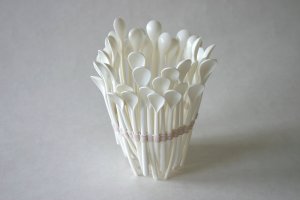 Jane Whitten’s basketry exists outside the genre’s established functional boundaries. My favourite from Canberra based Whitten’s recent Objectspace installation, Flight is composed of little more than a collection of plastic airline spoons woven into a small circular huddle with telephone wire. Flight embodies Whitten’s subtle found object approach to making. It is the self evident knowledge of aesthetic form and the ecological narrative in mass production which gives this unassuming and beautiful little work it’s conceptual gravitas. I love that this object, if it was to go on living in a domestic setting, would subtly remind me of all the permanent materials I’ve recently disposed of.
For Metro magazine ‘A Good Eye’ column 2007
-
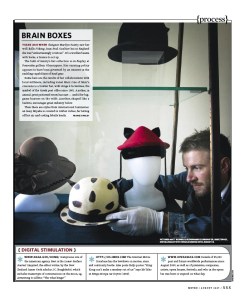
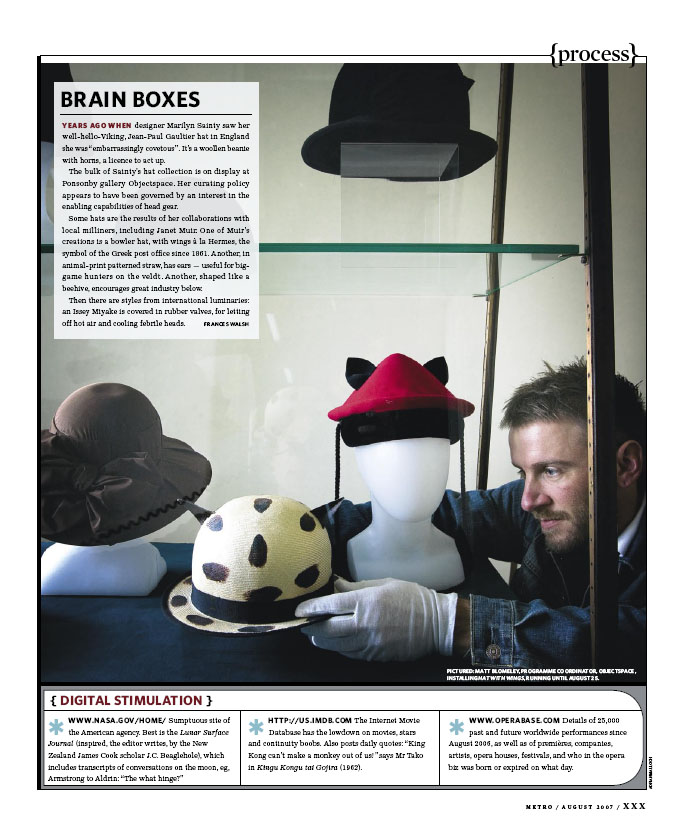
Metro ‘Process’ Feature – August 2007
-
Natural Selection 6

A gonzo-inspired story I wrote for Natural Selection issue 6 -
rm103 Nov/Dec 2006


MJ Kjarr at rm103 Auckland, Nov 23 – Dec 9, 2006
-
Appliance August 2006


August 2006 Appliance Artists Alliance NZ
-
It’s not that I’m Obsessed with you

Part I
‘I do not know which of us has written this text.’ – Jorge Luis Borges
1995: Over the course of several months, from a convenient vantage point I witness a pimply young guy with spiky hair and a black overcoat, stalking behind a fountain; watching and waiting outside the cafe I work at. Invariably he is an ex-boyfriend, consumed with abjection and obsessive behaviour.
2006: I keep crossing paths with an obsessive compulsive man. I met him at a fast food restaurant. He intelligent and interesting to talk with. After a short conversation he bids me farewell, leaves, then promptly returns three or more times. He twitches while repositioning his chair.
Part II
‘The thing that matters is not what they show me but what they hide from me
and, above all, what they do not suspect is in them.’ – Robert BressonIt is no secret that a large portion of art’s overriding narratives have become historicized, a by-product of the structural politics which played a large role in the late modern era conceptual works of the 1960’s and 70’s. The modernist abstraction of representation from the historical discourse that came first has served more as a refresher than death knell however, enabling a new generation as the radical commentary of the 60’s and 70’s was gradually institutionalized.
Re-personalizing photography as a critical voice operating regardless of boundaries, whether in galleries or fashion magazines, is in no small part due to the influence of theories like that summarized in Roland Barthes 1968 essay ‘Death Of The Author’. Barthes theory comprehensively questioned the importance of the artist, emphasizing the experience of the viewer as primary. Never less than a complex subject, photography is refreshed in such light and freed to access the full range of obsessive undercurrents that ultimately sustain inspiration, providing glimpses of reality – however distorted it may be.
It’s Not That I’m Obsessed With You represents the 16 graduating students of Unitec’s 2006 Bachelor of Design Photography pathway. Showcasing a wide range of styles and influences, the intrusive and obsessive nature of photography is explored, no doubt unveiling several potentially important new artistic voices.
Matt Blomeley



 A Bloc Carpentry Matt Blomeley