 The following makers/designers/artists, recent graduates from art, craft and design programmes around New Zealand, were featured recently in Best in Show 2010 (27 March – 8 May 2010) that I curated and installed as part of my role at Objectspace. The above link has images and the below texts regarding each maker, as well as a link to a free PDF download of the print publication.
Kristin D’Agostino
Investigating the relationship between the wearer and the jeweller, Kristen D’Agostino “attempts to scramble the current paradigm where one person makes and the other observes. In this case, both parties function as giver and receiver and as maker and viewer. It is an experiment in interchange and initiating relationships.” D’Agostino’s ‘relational’ forays within jewellery allow her to negotiate the boundaries of her practice both as a maker of jewellery and as a facilitator of projects such as the ‘Brooch of the Month Club’.
Nadene Carr
Applying details of her subject to a unique level of scrutiny, Jeweller Nadene Carr explores the subject of ‘the suit’. Reveling in the new discoveries uncovered by her approach, which crosses the boundary between accessory and apparel, she says “the transformation that I do want to present is its remodeling into an agent of art, quality in the materials and beauty in design. I am not concerned with garments that go in and out of fashion, or to be a passive symbol of status. It comes down to the relationship between the object and the wearer, and my questioning of the objects role on the body.”
Robyn Singh
Robyn Singh likens the process of resourcing materials for her jewellery to the feeling of having a sugar rush. It is fitting in this sense that these resources often come from such staples of our retail environment as ‘$2 shops’. “Walking away from the store” she says, “my sugar high turns into a low and guilt starts to overwhelm me. What am I going to do with all of them?” Rather than merely grabbing a bargain or indulging in retail therapy, Singh reinterprets the potential value of everyday objects, creating jewellery works which “suddenly transcend their original purpose and enter the realm of thoughtful and desirable objects. They become a unique multiple.”
Ko-Hsin Chen
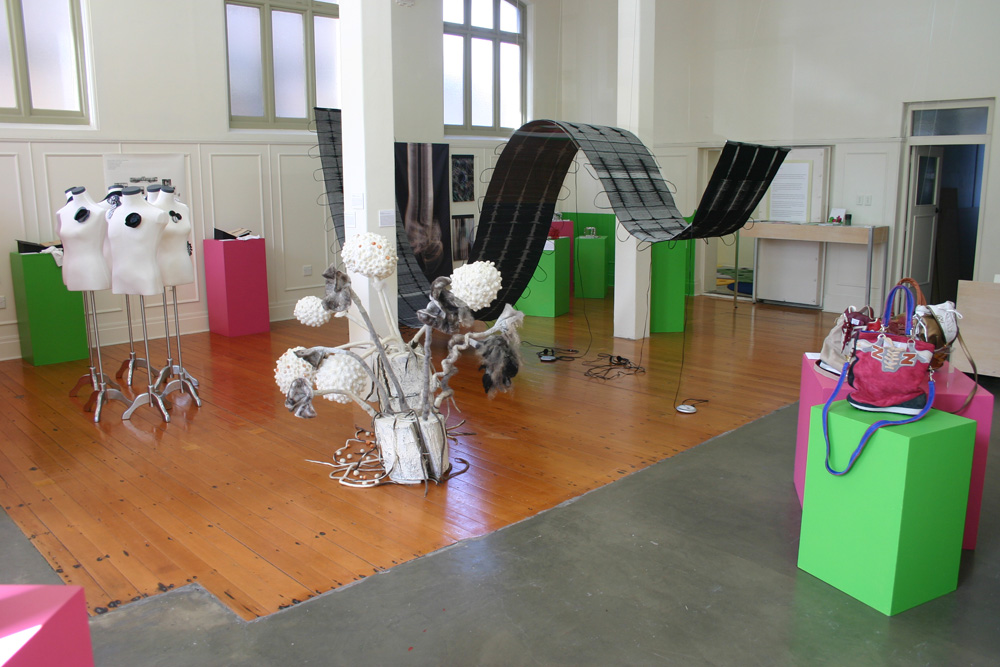
An awareness of the unnecessary accessories aimed at the blank spaces in our lives, feeds the practice of Ko-Hsin Chen, who observes; “we crave for unnecessary accessories all day every day, especially when there is a limited amount in supply.” Chen reinterprets these desires and has transferred the contemporary craving for sneakers into a range of bags fashioned from recycled retro-style shoes; perhaps drawing inspiration from previous eras when recycling was not necessarily ‘de rigeur’ but rather more of an economic and physical necessity.
Sunni Gibson
Sunni Gibson’s work questions “jewellery’s current and historic role as a signifier of status and wealth.” Gibson’s work is not focused upon upon one type of object, but represents multiple ways of viewing the subject. Treating a range of signifiers as both material and subject for jewellery, the works resulting from this interrogation are for Gibson embodiments of a thinking and making process that is engaged with our often problematic desire for luxury goods.
Matt Fanning
Textile designer Matt Fanning draws inspiration from his interests in optical effects, magic, cinema and geometry. His design practice encompasses a range of 2D and 3D elements and techniques with an emphasis upon exploring three dimensional space. Fanning observes that “directors and magicians control their audiences’ perceptions through the manipulation of space and time: my collection endeavoured to explore the manipulation of real and virtual space.”
Helen Perrett
At first glance Helen Perrett’s dog women may appear to some viewers as a statement about gender roles. Perrett on the other hand suggests a unique and empowering stance for these works when she quotes the artist Paula Rego, who said: “To be a dog woman is not necessarily to be downtrodden; that has very little to do with it … everywoman’s a dog woman, not downtrodden but powerful. To be bestial is good. It’s physical. Eating, snarling, all activities to do with sensation are positive. To picture a woman as a dog is utterly believable.”
Gwen Hudson
Gwen Hudson employs a background in fashion and textile to a series of work which combines her skills and applies them, using wet and dry felt techniques to create what she refers to as “ambiguous soft sculptural forms”. Although on one level a playful exploration, there is a serious message embedded in Hudson’s work about which she says ”these forms, representing affected mushrooms, are created around a theme of the dangers facing nature and nature’s fragility and susceptibility to manipulation and abuse.”
Raewyn Walsh
Raewyn Walsh describes her practice as moving freely “between jewellery and object and investigating the attachments we have to physical things … I am interested in the themes of collections, possession, function and purpose.” Among her investigations, Walsh’s use of the vessel, which she says represents “form and formlessness”, is a central element in her work. She is attracted both to the vessel’s utilitarian function as well as its tangible and intangible associations. Walsh intervenes with found objects, “cutting, adding new materials, and distorting shapes. I also transplant my own objects onto to them”.
Kate Butler
Jeweller Kate Butler says that her work “operates in what Julia Kristeva has called ‘women’s time.’ This is a time described as non-linear and cyclical and includes natural processes that require no agency. It is a system of ebb and flow. This notion of womens time encapsulates my process of collecting the remnants and non precious evidence of living.” Butler employs this theory using a crochet process that resembles the double helix structure of DNA. It is a fitting analogy as “each crochet stitch is a further link in the ancestral chain that I am working into … These crocheted works speak for me of complicated relationships – families meshed tightly which appear transparent on the surface but hide secrets within the mesh.”
Emma Grose
A recent excursion to Istanbul led textile designer Emma Grose to an inspired visit to a Turkish Rug shop. She writes that “the shop had a certain charm and sense of mystery about it, accompanied by a colorful shop owner, Hussein, who told wonderful tales of carpets, travel and the Turkish people.” Back in New Zealand and inspired by her travels, Grose used various photographic and digital techniques to distort light and create wonderful abstract photographic images which were then digitally printed onto fabric. The mystery and spirit of her adventures has been innovatively channeled into these works.
Corinne Lochner
Not many students would find a direct source of inspiration for their work in the building in which they undertake their study, but graphic designer Corinne Lochner did just that. Many people will know that ‘Building 1’ at Unitec is the historical site of the Oakley Hospital. She says “over the few years I studied at Unitec I was always told stories of what went on and I wanted to find out more.” Following up this interest, Lochner became inspired by “how and what went on at Oakley Hospital and having connections with people that used to work and were around when it closed as a mental hospital“. She then developed an in-depth historical project, producing and designing an intriguing new book about her findings.
Jade Muirhead
Taking inspiration from modular structures and kitset construction, Jade Muirhead’s jewellery is based on the principle of what she terms ‘kitset jewellery’. Taking on the issue of status, Muirhead says of her work; “the less you have the more you desire. Packaged in specific kits, the first kit shows what can be created if you join the second kit to the first, and then what you can have joining the third, thus leading you to want more … With play being the main factor, the wearer is the designer of their own body adornment.”
David Kaho
Graphic designer David Kaho says “being an Australian born Tongan who lives in New Zealand I have become more curious of my cultural identity”. For the final year of his design degree identity became a key influence in his design practice and saw Kaho creating a suite of work aimed at helping “understand the differences between Western and Polynesian cultural to create an understanding within myself.” The resulting publication is closely related to a poster designed to promote the. The poster is very interesting as a stand-alone project. For this Kaho designed a “contemporary-pacific heading typeface to compliment the publication. It had references to a common polynesian motif and weaving.”
Sita Main
Designer Sita Main’s ‘Furoshikability’ shelving system was “initially inspired by the decorative and fluid nature of traditional Japanese Furoshiki, the art of folding textiles to create a myriad of forms.” Main describes an interest in “the physical nature of furoshiki from how it was knotted, rolled and folded to the nature of the textiles being fluid and soft yet able to be transformed into various structures which always revert back to a simple square piece of fabric … ‘Furoshikability’ was a term coined by Korean author O’ Young Lee who wrote ‘Furoshiki Culture’ and refers to a traditional eastern way of life which favours a flexible approach over the more fitted ones of the West.”
Emma Cullen
Emma Cullen treats jewellery practice as a fluid and experimental creative process. She describes her 2009 body of work as being “made up of smaller ‘projects’, which are interconnected, particularly through the process (thought process, set of rules) they are made with and through the hand of the maker.” An initial glance at Cullen’s work suggests a selection of disparate objects. This estimation is in one sense correct however Cullen elaborates, saying that her objects “relate to experiences – each is a visual response to an investigation of my own practice, my working method, my life experience, and my person … I like to be reminded that the objects exist outside of a formal context.”
Lars Preisser
Lars Preisser recounts his upbringing In Germany where part of his family was involved with industrial looms. He recalls “I was able to see these weaving machines in action a few times. They are extremely fast and the noise they produce is so loud that you had to wear ear protection.” In exploring weaving as an artist Preisser emphasises the repetitive motions and sounds of the machine along with himself as the weaver. Integrating audio cable into the weaving, Preisser provides the listener with “an insight into the process of the weaving by echoing its own creation” and notes that “I am always aware that the computer is historically dependent on the loom. It’s the question of where something begins.”
Matt Blomeley
 A Bloc Carpentry Matt Blomeley
Leave a comment