It seems every young kid is destined to undertake certain ill-conceived acts and then remain ashamed of such activities well into adulthood. This kind of lingering shame would hopefully indicate an aversion from a future life in crime for the majority of us. An example: Hacking into my mum’s painting easel with a knife. what was I thinking? It was the early 1980’s and I was an easy-going country kid; a typical boy who fished for eels in the creek over the road and a keen reader who was also into drawing and painting. Trucks, animals, family members, houses, cartoon characters, etc; I drew them all. This predilection towards art makes the vandalistic action upon a painting easel appear slightly ironic.
There is probably a Freudian case study which would explain my one or two lawless acts during these years. For example, the easel from Freud’s perspective is possibly an untouchable ‘clan totem’ (1) from my childhood. In some sense the easel predestined my attendance at art school by twenty or so years. What then of hacking into it with a pocket knife? Fortunately I wasn’t born of a different era or locale; Freud notes the totem is accorded utmost respect among worshippers; in past ages violations of ‘totem taboos’ met with with harsh consequences, to say the least. (2)
In as much as it could have been the spirited rebellion against a taboo, or understandable frustration in not being able to use my mother’s oil paint with the same virtuosity as a felt tip pen, it was not in this instance an act of anger or frustration. I believe now, as I did then, that this action was simply the intoxicating combination of an exotic and unobtainable looking material meeting a pocket knife blade.
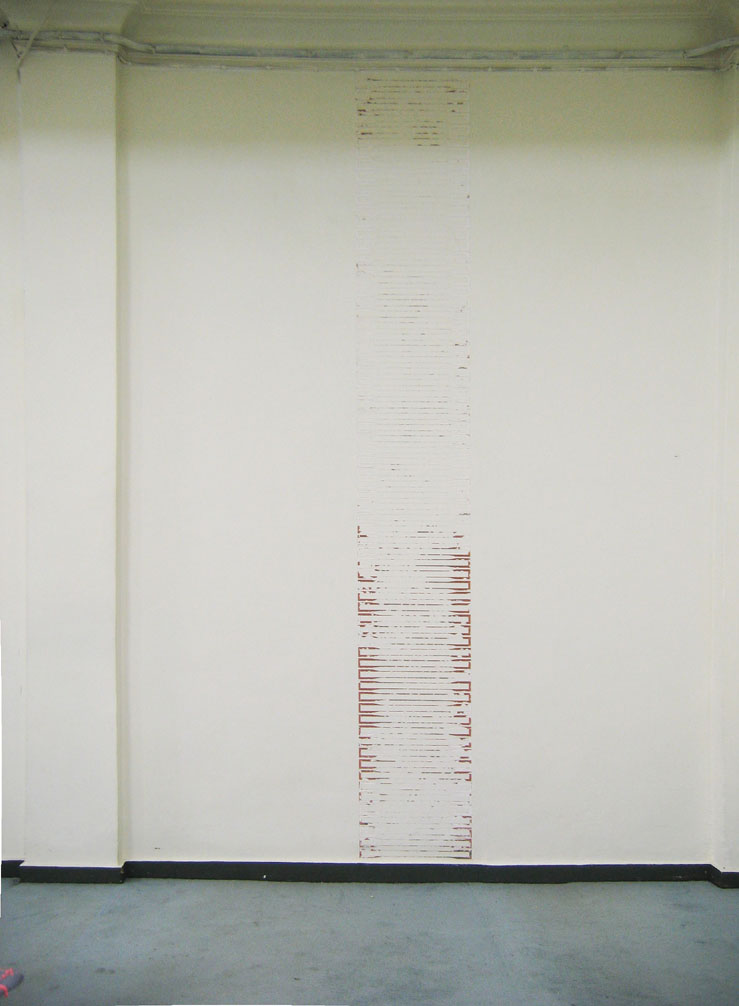
Although no longer able to visually recall hacking into this easel, I still respond viscerally from the incident – even following an art school education – to the notion of carving into something permanent or solid. The easel, thirty or so years later still in regular use by my mother, was the first thing I thought of when I came upon the art gallery wall carvings of Patrick Lundberg in 2006.
The transience of Lundberg’s work, in that these carvings, or excavations, will happen for a short period of time and disappear with the first swipe of polyfilla, imbue viewers with the feeling that despite the limited time frame of an artists gallery showing, his works – being as they are ‘carvings’ – are something other than temporary. Fittingly, the walls of rm103 gallery in downtown Auckland still bear the faint shapes of Lundberg’s 2006 exhibition, as he recently pointed out to me at a gallery opening. Whether or not this story relays an intentional aspect of these works is not really the point, but it illustrates the sense of permanence the viewer may experience as an immediate response to Lundberg’s work.
Lundberg’s wall carving work is predominantly destined to occupy a concept of temporality, although this is not entirely related to the time alloted an art exhibition. Foregrounding the temporality in Lundberg’s work is the recent emergence of a culture within many presenting institutions and major public museums for the authentic and live experience. This is of course an addition to the regular presentations of new and old ‘pre-approved’ objects. The nature of the live experience however is that it is almost lost before it began and so the historical moment passes irretreviably.
While not suggesting a criticism of this institutional framework, to the regular patron of an institution Lundberg’s work in a sense bridges the gap between the varying degrees of dialogism captured in an institution’s past exhibitions, and the currently popular souvenir-like live event. The process of skillfully marking and cutting the outline of a drawing then delicately removing strips of paint from the gallery wall uncovers stratified layers from previous exhibitions and often previous artists site specific wall works; all within a precise and site specific drawing. (3)
This brand of virtuosity with a scalpel blade suggests the continued potential and importance of painting in conceptual art and critical theory. Lundberg is ungrudgingly attempting to engage with multiple possibilities. At the same time, it appears – despite the different intellectual references – that he relishes the opportunity and sentiment of digging his way through various histories of the institution, at least as much as I secretly enjoyed hacking into an easel with a knife.
Matt Blomeley
1. Freud, Sigmund. Totem and Taboo, The Return of Totemism in Childhood, Routledge Classics, 2001, London, (pp120). Quoting from J.G. Frazer’s Totemism and Exogamy (1910), Freud suggests there are “at least” three kinds of totem, “(1) the clan totem, common to a whole clan, and passing by inheritance from generation to generation; (2) the sex totem, common either to all the males or to all the females of a tribe, to the exclusion in either case of the other sex; (3) the individual totem, belonging to a single individual and not passing to his descendants…”
2. ibid, “The rules against killing or eating the totem are not the only taboos; sometimes they are forbidden to touch it, or even to look at it; in a number of cases the totem may not be spoken of by its proper name. Any violation of the taboos that protect the totem are automatically punished by severe illness or death” (pp120)
3. Wright, Richard, Richard Wright, Richard Wright and Thomas Lawson in conversation, Milton Keynes Gallery, UK, 2000. Wright observes of his painting practice, which displays an interest in site specificity similar in some respects with Patrick Lundberg, “It’s not so much about the individuality of ideas, but the quickness of how an idea gets translated through the agency of something like skill. It’s karaoke shit really. The sheer dumbness of trying to transmit something through your own body – being forced to find definitions. The agency of this kind of manoeuvere that, against the odds, allows you to come up with the goods.”
 A Bloc Carpentry Matt Blomeley
Leave a comment