“Numismatology, pharmacology and archaeology have been reformed. I understand that biology and mathematics also await their avatars…. A scattered dynasty of solitary men has changed the face of the world. Their task continues. If our forecasts are not in error, a hundred years from now someone will discover the hundred volumes of the Second Encyclopedia of Tlön.”
– Jorge Luis Borges, Labyrinths: Selected Stories and Other Writings, 1962.
When I heard the title of this new painting installation by Kirstin Carlin and Krystie Wade, I was momentarily confused as to whether I was meant to be associating the ‘Rama’ in Hindu mythology, or the ‘–rama’ in panorama and diorama. In some sense both are equally applicable, as painting, even in its most factual moments, is able to freely dip into fiction or mythology, often embodying a Borges-like feeling of empiricism and liminal exploration.
Confusion about the meaning of the exhibition title was doubtless not the point they were intending, as I know both artists are aware the painted panorama is a peculiar moment in both history and art history, so it was most likely this definition. Anyhow, the conjunctive apprehension of multiple usages, as suggested above, is perhaps a fitting analogy for the exhibition, Speaking in Ramas, for reasons that will follow.
Prior to the advent of photography and the moving image, the painted panorama was a significant and popular simulacrum of the real (and imagined) world in nineteenth century Europe. The most impressive of these were installed in gigantic purpose-built circular rooms replete with artificial fragrances and breezes to stir the imagination and satisfy the vogue for ‘Grand Tour’ experiences. The visitor would enter the panorama via a staircase and be greeted by a handrailed circular viewing platform and a dizzying, continuous painting surrounding the platform.
The paintings produced by surveyors and botanists which were used to peddle the idea of immigrating to New Zealand, paintings which we now hold dear within institutional collections, would have seemed tame by comparison to the fecundity of the panorama which was then all the rage in European cities. Until photography and the moving image, painting was considered as much a mechanical art as a tool for the imagination. The panorama amplified this view, accentuating the desire of many people for instantaneous travel to historically poignant places and past events.
More recently photography has been employed in the realisation of these often massive panoramas, but painting remains of course the only tool appropriate for conveying the information at such a scale. Although panorama painters often relied on technologies like photography and the camera obscura to capture the sense of a real place, just like those early panoramists Carlin and Wade also draw upon the imagination and a plethora of images (now freely available online) to imagine their own places. Although not recreating the 360 degree panoramic spectacle in their works for Speaking in Ramas, both artists have nonetheless engaged with the manner in which panorama pulled together elements that could not be seen in a single painting or photograph.
Having attained a similar command of the ‘hairy stick in mud’, as our art school lecturer once described it, several years down the track into their respective careers Carlin and Wade are ensconced within the mutable history of painting. Both artists, in their own way, envisage panoramic mise-en-scènes using a variety of techniques and mediums in their drawing and realisation processes.
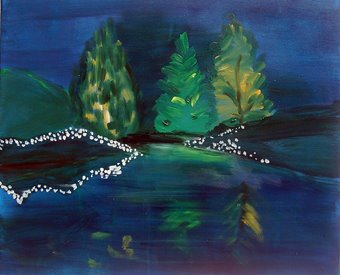
Carlin’s latest paintings utilise Google image searches in a series of works which here interpose the Christchurch Botanic Gardens with the Royal Botanic Gardens in Kew, London. It is an effort by the artist “to create [her] own fantasy gardens”. Bringing together elements that, like the panorama, are “isolated or scattered around an area too vast to be perceived in one go,” Carlin revisits the conservative vision that Europeans had for New Zealand cities with her own eyes, prompting the viewer to wonder whether new vistas need not always be a glass, stone and concrete simulations of another place, but perhaps have just a strong a validity when their representations emerge merely from flights of the imagination.
Wade’s paintings combine all the twists and tangles of the three dimensional landscape, drawing the viewer into an experience of imagined natural settings that exist within the frame of the canvas. The feeling of movement is an intentional characteristic of her works, which often feature plateaus and garden elements haphazardly linked into path-like constructions, drawing the viewer around a space deliberately held within the constraints of the canvas. Wade quotes the artist Laura Owens: “It’s odd to think of paintings as static, they are so much more. They don’t move like film but seem to have a lot more movement than photography.”
Digital technology, with its potential to faultlessly distort the truth captured within photographic images, often uses drawing and painting inspired ‘tools’ within computer applications like Photoshop, and as such seems to have loosened the captivating, alchemical mantle that technologies such as the panorama and photography originally displaced, but could not replace, from the medium of painting. In as much, the majority of digital drawing technologies used to manipulate images do not seem to have moved beyond emulating collage-like drawing and photographic retouching techniques.
If digital media has freed or reinvigorated public perception of the painting, it also seems to be responsible for other ‘mechanical’ or ‘technical arts’ regaining status in the challenging and decidedly panoptic world of contemporary fine art. It is not uncommon now, for instance, to see ceramic, textile and jewellery practice exhibited alongside painting and installation art within contemporary art galleries and major exhibitions. The panorama may no longer be relevant as a specific optical technology but the role it has played and the influence it still represents remains omnipresent.
Matt Blomeley
07 February 2009
– Speaking In Ramas is a new exhibition at Physics Room gallery in Christchurch, 18 February – 14 March 2009.
– Image courtesy Kirstin Carlin and Anna Miles Gallery.
 A Bloc Carpentry Matt Blomeley
Leave a comment